Why grills stop lighting in Orange County
Salt air, moisture, and grease build-up are the big three here in OC. Over time, they corrode igniters, clog burner ports, and weaken spark.
The 7 quick fixes (5–10 minutes each)
1) Confirm gas supply & valves
- Make sure your tank has fuel (or your natural gas shut-off is open).
- Open the tank slowly to avoid tripping the regulator.
- Verify the knob sequence: gas on → igniter press → burner knob to “light”.
2) Replace the igniter battery (many Lynx/Weber modules use AA)
- Unscrew the igniter module cap; replace the AA battery with the positive end out.
- Press the igniter: do you hear a rapid clicking? If not, the module may be faulty.
3) Clean the electrode tip & adjust the gap
- Remove the grates and heat plates.
- Use a cotton swab or soft brush to clean carbon from the electrode tip.
- Gap check: about the thickness of a nickel between tip and burner.
4) Clear clogged burner ports
- With gas off and burners cool, use a thin wire to clear each port.
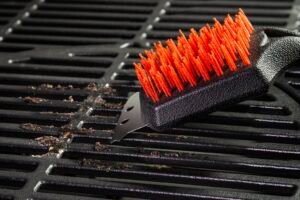
- Brush along the burner tube to remove debris; keep ports facing evenly.
5) Reset a stubborn regulator (weak flame or whooshing out on wind)
- Turn everything off (burners + tank).
- Disconnect the hose for 60 seconds, reconnect, and reopen the tank slowly.
6) Check GFCI & power (for grills with glow plugs/rotis motors)
- Many Lynx/Fire Magic models use powered igniters or glow plugs.
- Test the GFCI outlet; press RESET. If it trips again, call a technician.
7) Dry out after coastal fog or rain
- Remove grates and heat plates; towel dry.
- Run the grill on high for 10–15 minutes to evaporate lingering moisture.
Brand notes (OC favorites)
- Weber Genesis/Summit: AA battery modules; watch for spider webs in venturis.
- Lynx Professional/Sedona: powered ignition/glow—verify outlet & battery where applicable.
- DCS Series 7/9: electrode alignment matters; keep ports spotless for even light-off.
When to call a professional (and why it’s worth it)
- Persistent gas smell, popping light-offs, or flame lifting off the burner
- Melted wires or cracked ceramic electrodes
- Uneven heat even after cleaning (possible regulator or manifold issues)
We’ll run a full ignition & gas-leak inspection, test regulators, descale burners, and replace worn electrodes—usually same-week in Irvine, Newport Beach, Huntington Beach, Costa Mesa, and nearby.
Prevent the next no-light moment (OC maintenance rhythm)
- Every 2–3 months (coastal): quick clean, wipe electrodes, brush burners
- Every 6–12 months: professional deep clean & inspection
- After heavy rain/marine layer: dry-out burn for 10–15 minutes
FAQs
My igniter clicks but there’s no flame—what now?
Check gas flow, burner clogs, and electrode gap. If the click weakens or you see arcing to the firebox wall, the wire/electrode may be failing.
Can I use a match to light it?
Yes, if your model supports manual lighting—but only after you’ve aired out the firebox for several minutes.
How long does a pro repair take?
Most ignition fixes take 45–90 minutes once parts are on hand; complex wiring or manifold work can take longer.